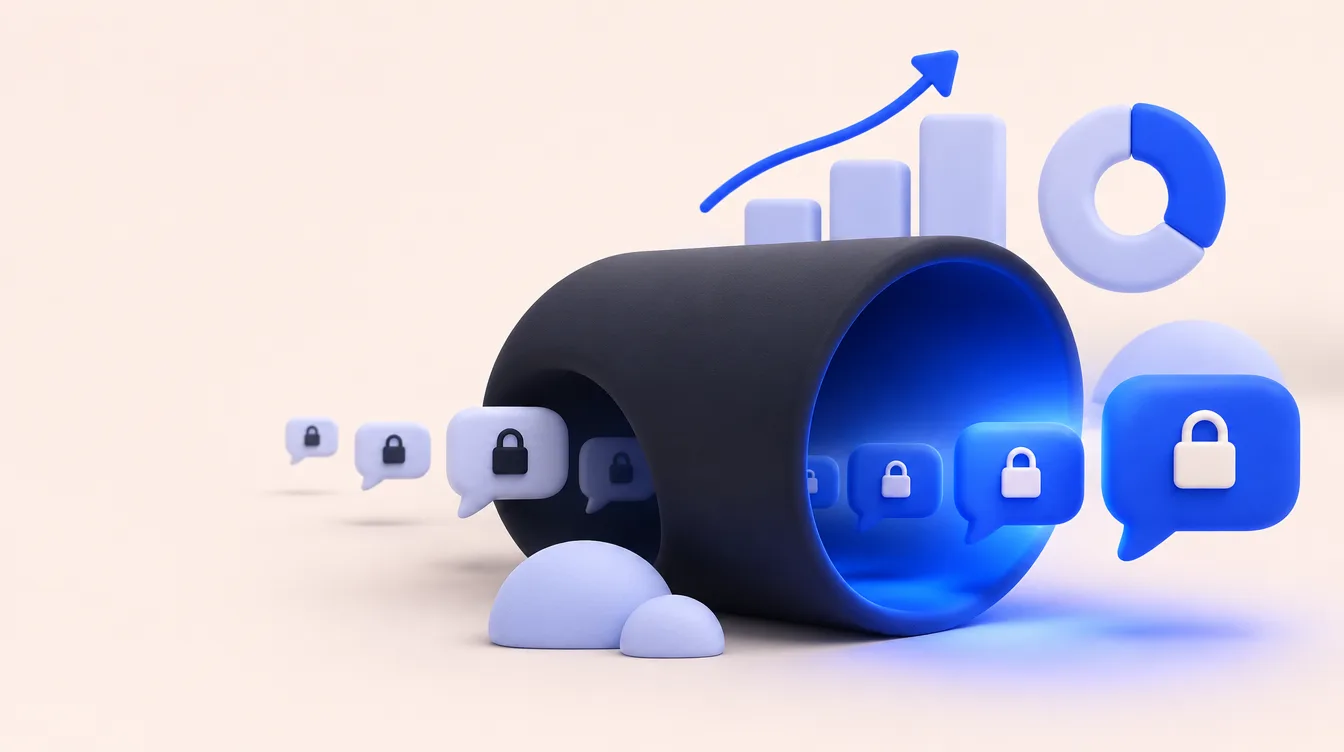
Dark social attribution is the practice of estimating how many leads and sales come from private sharing, such as WhatsApp, Messenger, Slack, text messages, email and DMs, where links arrive without referrer data and land in your analytics as "Direct". You cannot track it perfectly, but you can measure it well enough to make budget decisions by combining three methods: tagging the links you control, isolating suspicious "Direct" traffic, and asking buyers how they found you.
This guide explains where the term comes from, why the data disappears, and a step-by-step method you can run in a spreadsheet or attribution tool this month.
What is dark social?
The term spread through Alexis Madrigal's October 2012 article in The Atlantic, "Dark Social: We Have the Whole History of the Web Wrong", which used Chartbeat analytics data to show that a large share of The Atlantic's social traffic arrived with no referrer at all. The idea is simple: when someone copies a link and pastes it into a private chat, the click that follows often carries no information about where it came from.
Google Analytics 4 defines the Direct channel as the channel by which users arrive "via a saved link or by entering your URL" (GA4 default channel group). A shared WhatsApp link that loses its referrer looks exactly like that, so it is counted as Direct even though a person recommended you.
You will find many statistics online claiming dark social is 69%, 84% or even 95% of sharing. Most come from vendor reports published between 2014 and 2016, so treat them as historical context, not as a benchmark for your business. Your own data is the only number that matters.
Which channels count as dark social, and what do you see?
| Where the share happens | What analytics usually shows | Can you recover it? |
|---|---|---|
| WhatsApp chats and groups | Direct | Partly, with tagged share links and self-reported answers |
| Slack, Teams, Discord | Direct or the app's referrer, depending on how the link opens | Partly |
| Email forwards and newsletters without UTMs | Direct or the email client | Yes, if you tag every link you send |
| Instagram, TikTok and LinkedIn DMs | Direct or the social app, inconsistently | Partly |
| Copy-paste from in-app browsers | Direct | Rarely |
| Podcasts and offline word of mouth | Direct or branded search | Only by asking |
One important exception for Mexico and LATAM: Click-to-WhatsApp ads are not dark social. Meta's WhatsApp Business Platform webhook reference shows a referral object on messages that start from an ad, with fields such as the ad's source ID and a click ID. If you store those fields in your CRM, the lead is trackable. Our guide to tracking Click-to-WhatsApp ads to revenue covers that setup.
Why does dark social break attribution?
Attribution models can only distribute credit among the touchpoints they see. When a recommendation in a group chat starts the journey, the model never sees it, so the credit flows to whatever comes next: Direct, branded search or a retargeting ad. That has three practical effects.
- Brand and paid search look stronger than they are, because they capture demand that started in private conversations.
- Content, community and PR look weaker, because the shares they generate turn into "Direct".
- Last-click models amplify the problem, as we explain in what last-click attribution hides.
How do you measure dark social, step by step?
- Tag every link you control. Add UTM parameters to newsletters, sales email signatures, WhatsApp broadcast messages, community posts and creator links. Use a consistent naming convention so "whatsapp", "WhatsApp" and "wa" do not become three sources. Our UTM naming convention guide has a template.
- Add share buttons that carry tags. A "Share on WhatsApp" button on a pricing page or article can append utm_source=whatsapp and utm_medium=share to the shared URL. You will not capture copy-paste shares, but you will capture some.
- Split Direct traffic by landing page. Real direct visits usually land on the home page or short, memorable URLs. Direct sessions that land on long, deep URLs, like a specific blog post or a pricing page with a query string, are much more likely to be shared links that lost their referrer.
- Exclude known direct behavior. Filter out internal traffic, returning logged-in users, bookmarked app pages and staff. What remains on deep URLs is your "likely dark social" estimate.
- Ask buyers. Add a "How did you hear about us?" field to your demo, quote or booking form, with options like "Recommendation from a friend or colleague" and "Someone shared a link in a chat". See our full guide to self-reported attribution.
- Connect it all to CRM revenue. Pass UTMs, landing page and the self-reported answer into the CRM as fields on the contact and the deal, so you can report closed revenue by source, not just sessions.
- Compare trends, not single days. Review the likely-dark share monthly and look at whether it moves when you launch content, a community program or a referral push.
Worked example: estimating dark social from "Direct"
Example (hypothetical numbers): a B2B software company sees 4,000 Direct sessions in a month and 160 demo requests attributed to Direct.
| Direct sessions by landing page | Sessions | Demo requests | Interpretation |
|---|---|---|---|
| Home page and short URLs | 2,200 | 70 | Mostly true direct and brand recall |
| Deep blog and guide URLs | 1,300 | 40 | Likely shared links (dark social) |
| Pricing and comparison pages with long URLs | 500 | 50 | Likely shared during internal buying discussions |
The estimate: 1,800 of 4,000 Direct sessions (45%) and 90 of 160 Direct demo requests (56%) are likely dark social. Now check the self-reported field. If 70 of those 90 demo requests answered "recommendation" or "someone shared a link", the estimate is reasonably supported. If most answered "Google", your landing-page rule is too broad and you should tighten it.
Suppose 90 demo requests per month turn into 9 closed deals at an average of $12,000. That is $108,000 of revenue that a last-click report would credit to "Direct" and that no channel owner would defend in a budget meeting. Making it visible changes the conversation about content and community spend.
What are the limits?
- It is an estimate. Landing-page rules and survey answers are both imperfect. Report a range, not a precise number.
- You cannot tag copy-paste. Most private sharing happens by copying a URL from the browser bar, which carries no tags you add later.
- Privacy is a feature, not a bug. Messaging apps protect users by not sharing context. Do not try to fingerprint or identify individuals to work around that.
- Small volume is noisy. With fewer than a few dozen conversions a month in the likely-dark bucket, month-to-month swings mean little.
- It does not prove causation. To learn whether a content or community program creates demand, you still need a holdout or a before-and-after test with a clear control.
Who this is for, and when it doesn't apply
It matters most for B2B and considered purchases where buyers forward links to colleagues, for brands in Mexico and LATAM where WhatsApp is the default way to share, and for companies investing in content, community, PR or podcasts.
It matters less for impulse ecommerce driven almost entirely by paid social with direct clicks, or for businesses where nearly every sale starts from a tracked ad.
How does Admira help with dark social?
Admira cannot see inside private chats, and no tool can. What it does is keep the trackable part clean: it ties Meta, Google Ads, TikTok and Click-to-WhatsApp leads to CRM revenue with cookieless tracking by default, and shows each buyer's journey so the untracked "Direct" share is clearly separated from paid and tagged sources. You can then compare that share with your self-reported answers. See Admira's attribution software or WhatsApp ads attribution for details.
FAQ
What is dark social traffic?
It is traffic from links shared privately, in messaging apps, email or DMs, that arrives without referrer data. Analytics tools usually count it as Direct.
Who coined the term dark social?
The term spread through Alexis Madrigal's October 2012 article in The Atlantic, which used Chartbeat data to show how much traffic arrived without a referrer.
Is WhatsApp always dark social?
No. Organic shares in chats usually are, but Click-to-WhatsApp ads include referral data on the first message, so those leads can be tracked if you store the fields in your CRM.
Can GA4 track dark social?
Not directly. GA4 puts referrer-less visits into Direct. You can estimate dark social by analyzing Direct sessions by landing page and by tagging the links you control.
Do UTM parameters solve dark social?
They solve part of it. UTMs survive when people share the tagged link you sent, but not when they copy a clean URL from the browser.
How accurate is a dark social estimate?
It is directional. Combine landing-page analysis with self-reported answers and report a range, then watch the trend over several months.