
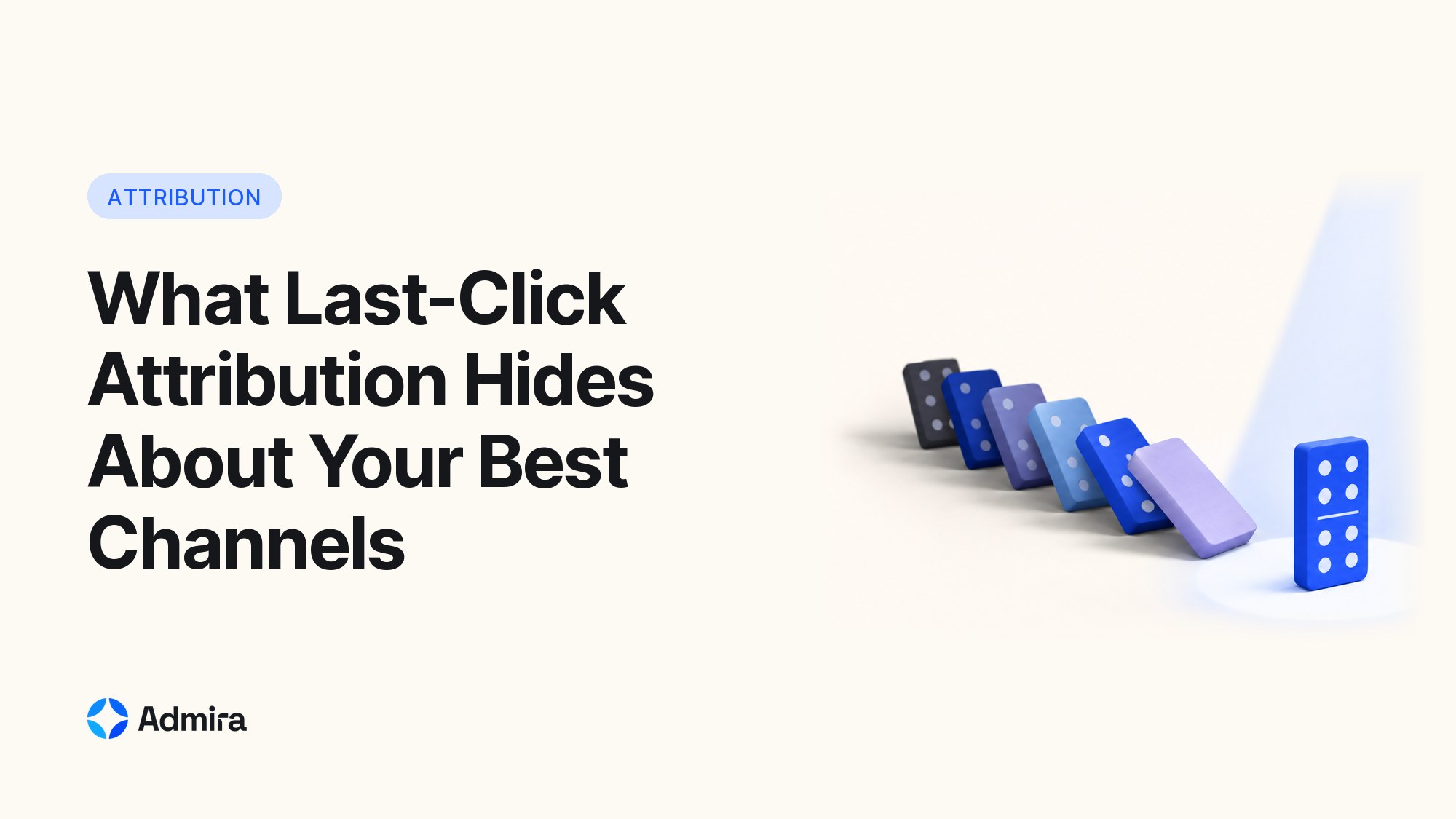
Last-click attribution gives 100% of the credit for a sale to the final touchpoint before purchase, and hides every channel that created the demand in the first place. It systematically over-credits branded search, retargeting, and direct traffic, while making paid social, video, influencer, and content look worse than they are. If you budget by last-click, you will keep funding harvesters and starving the channels that fill your funnel.
How last-click distorts the picture
Most purchases involve several touches. A typical ecommerce path might be: sees a TikTok ad, watches an influencer review, googles the brand, clicks the branded search ad, buys. Last-click hands the entire sale to branded search. The three touches that actually built intent get zero credit, even though the sale would never have happened without them.
Repeat that across thousands of orders and your reports tell a consistent lie: bottom-funnel channels look phenomenal, top-funnel channels look unaffordable. Teams then cut prospecting, and weeks later branded search volume and retargeting pools shrink, because the demand engine was quietly unplugged. The metric that looked so clean set off a slow-motion decline nobody connected back to the reporting choice, since the damage shows up in a different channel and a different month than the cut that caused it.
The channels last-click punishes most
- Paid social prospecting. Introduces the brand to new buyers who convert later through search or direct, so it almost never gets the last click.
- Video and YouTube. Rarely the last click, frequently the first meaningful exposure that starts the journey.
- Influencer and creator content. Drives search and direct behavior that other channels then capture and get credited for.
- Content and SEO for non-branded terms. Educates buyers early, then converts them weeks later under someone else's name.
The channels last-click flatters
Branded search converts people who already decided. Retargeting reaches recent site visitors who were close to buying anyway. Email captures existing customers and warm leads. All three matter operationally, but their last-click numbers describe position in the journey, not incremental value. A channel can be last 80% of the time and still add little revenue you would not have earned anyway.
B2B SaaS teams feel this even harder. A six-month journey of podcast mentions, LinkedIn content, webinars, and comparison research ends with someone googling the product name and filling a demo form. Last-click writes the whole deal to "organic search, branded," and the CFO reasonably asks why the paid budget exists at all. The honest answer is that the paid budget created the search, but last-click cannot show it.
There is a compounding trap here. Because last-click makes bottom-funnel channels look so efficient, teams pour more budget into them, which inflates their reported ROAS further and makes prospecting look even worse by comparison. The reporting choice becomes a self-reinforcing loop: the more you trust it, the more it skews your allocation, and the harder it becomes to notice that your overall growth has quietly stalled while your dashboards still glow green. Breaking that loop requires a measurement method that can see the touches last-click throws away.
When last-click is fine, and when it fails
Last-click is reasonable when you sell an impulse product with a one-session buying journey, when you run a single channel, or when you need a simple tiebreaker inside one platform's ad-set comparisons. In those narrow cases its simplicity is a feature, not a flaw.
Multi-touch attribution is better when you run three or more channels, your consideration cycle spans days or weeks, you spend meaningfully on upper-funnel formats, or you are deciding where the next dollar of budget goes. That describes most ecommerce and essentially all B2B SaaS, which is why last-click causes so much damage in practice.
How to see what last-click is hiding
- In GA4, compare the default reports against the Attribution paths report to see how many conversions were genuinely multi-touch.
- Segment branded versus non-branded search. If branded carries most of your "search" revenue, something upstream is generating those searches.
- Run a holdout or geo lift test on a "low-performing" prospecting channel before you kill it. If total revenue drops more than that channel's last-click revenue, last-click was hiding its real contribution.
- Adopt a multi-touch model that distributes credit across the journey, then compare channel rankings against your last-click view. The channels that move most are exactly the ones last-click was misjudging.
Admira gives you that combination in one platform: cookieless multi-touch attribution, marketing mix modeling, and incrementality testing on a single first-party foundation, so prospecting and branded search finally get judged on the same fair basis. If you suspect last-click is quietly starving the channels that fill your funnel, book a demo and we will show you how your channel rankings shift under a model that credits the whole journey.
FAQ
Isn't data-driven attribution in GA4 already fixing this?
GA4's data-driven model helps within what GA4 can see, spreading credit across the click path rather than dumping it all on the last touch. But it still misses view-through impressions, walled-garden touches, and anything lost to consent gaps and ad blockers. Treat it as one useful input that improves on last-click, not as the final verdict on channel value across your whole media mix.
If last-click is wrong, why does everyone still use it?
Because it is simple, available by default in every platform, and every stakeholder understands it instantly. That simplicity is genuinely valuable for quick reporting and bookkeeping. The mistake is using last-click for budget allocation, where its bias toward bottom-funnel channels actively misleads you, rather than treating it as the rough convenience metric it really is.
Should I cut branded search then?
Not automatically. Branded search often carries real incremental value, especially as a defense against competitors bidding on your name, and cutting it can hand traffic to rivals. The point is not that branded search is worthless, only that its last-click numbers overstate its role. Test it with an incrementality experiment instead of deciding by ideology in either direction.
What should replace last-click for budget decisions?
A combination rather than a single replacement: multi-touch attribution for channel-level credit, marketing mix modeling for budget scenarios and cookieless coverage, and incrementality tests for the decisions with the most money at stake. No single method is complete, but together they give you a far fairer read on which channels actually drive revenue than last-click ever could.


.svg)
%20(2).png)