
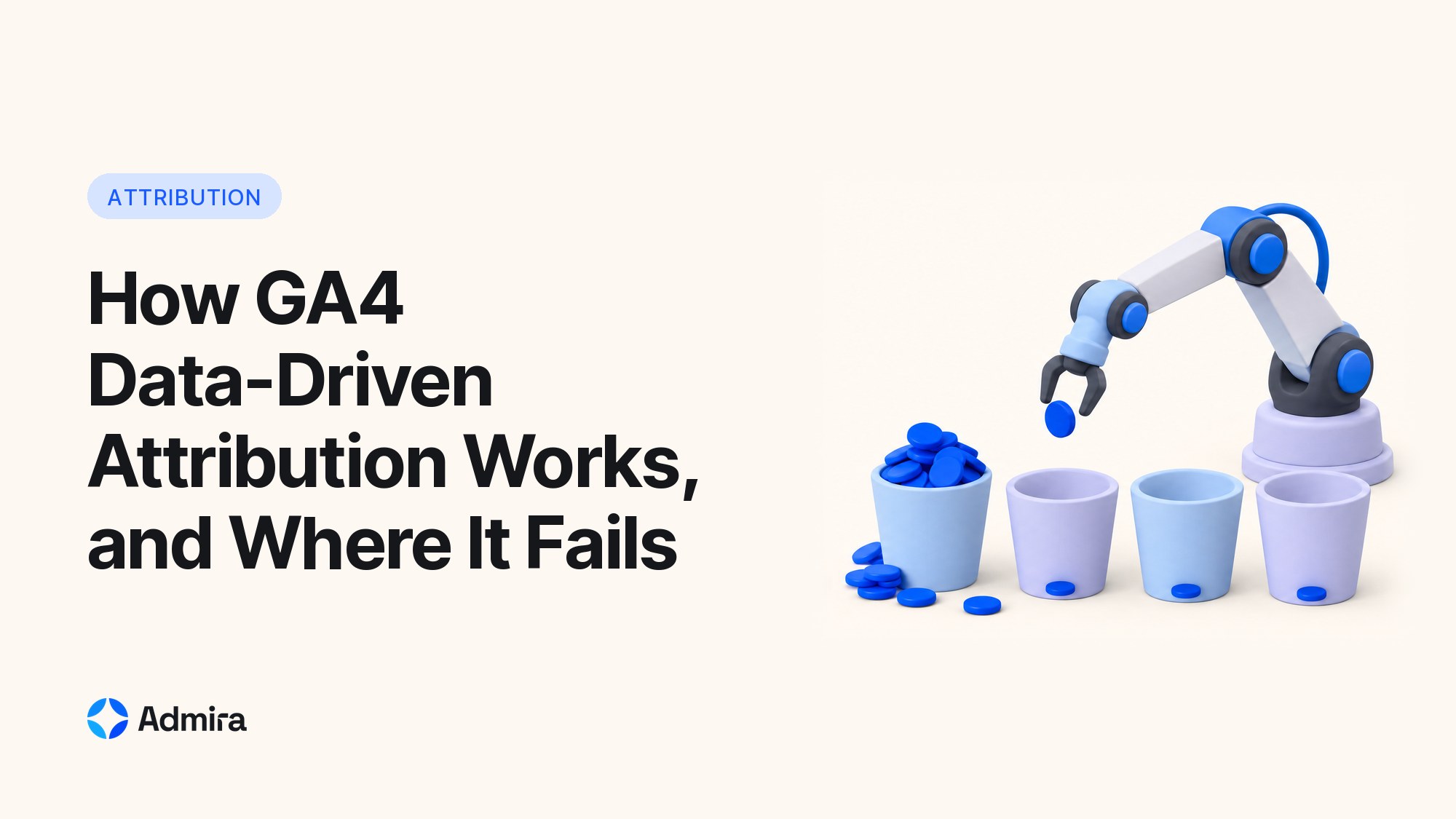
GA4's data-driven attribution (DDA) uses a machine learning model to split conversion credit across the touchpoints Google can observe, based on how much each interaction changed the probability of conversion. It is genuinely smarter than last click, but it only models the data Google sees: Google Ads clicks and tagged sessions on your site. Impressions and clicks inside Meta, TikTok, or LinkedIn that never produce a tracked session are invisible to it, so those channels get structurally undercredited.
What data-driven attribution actually does
DDA is a counterfactual model. GA4 compares the paths of users who converted against similar users who did not, and estimates how much each touchpoint shifted the odds of conversion. Credit is then distributed in proportion to that estimated contribution, using an approach similar to Shapley value analysis combined with path data. In plain terms, it asks: how much did this touch actually move the needle, versus how much would have happened without it?
Inputs include the channel, the time between touch and conversion, the device, the number of ad interactions, and the type of engagement. Unlike rules-based models, the weights are recalculated continuously from your property's own data, which is why two businesses can see very different credit splits for identical-looking paths. The model is bespoke to your data, not a fixed formula.
Where DDA works well
DDA is a real improvement over last click when three conditions hold. First, most of your paid media runs through Google's ecosystem, so the model can see the majority of touchpoints. Second, you have enough conversion volume for the model to learn stable patterns rather than noise. Third, your site tagging and consent setup are healthy, so sessions are actually captured instead of being silently dropped by misconfigured GA4 settings.
For a search-heavy advertiser, DDA usually redistributes credit sensibly: generic search and YouTube get more, brand search gets less. That directional shift is typically more honest than last click, which would have handed the final branded-search click nearly all the credit for demand that other touchpoints created.
A quick example of credit shifting
Say a user searches a generic term, watches a YouTube ad two days later, then returns via a branded search and buys. Last click would hand all credit to the branded search. DDA instead spreads it: maybe forty percent to the generic search that started the journey, thirty-five to the YouTube view, and only twenty-five to the branded search that merely closed it. That redistribution is the whole point, and within Google's own inventory it is usually a fairer picture of what really drove the sale.
Where it fails
The failures are not bugs; they are structural consequences of what GA4 can and cannot see. Knowing them keeps you from over-trusting the output.
- It only credits what it measures, and it measures Google best. A Meta or TikTok view that influenced a later brand search never enters the model. The brand search does. Google-visible touchpoints absorb the credit that off-platform media actually earned.
- No view-through outside Google inventory. GA4 can incorporate engaged views from YouTube, but a paid social impression that drove a conversion without a click simply does not exist in the dataset.
- Cookie and consent loss. Safari's tracking prevention, ad blockers, and consent banners remove sessions before the model ever sees them. Consent mode fills gaps with modeled conversions, which adds another layer you cannot audit.
- It is a black box. You cannot inspect the weights, reproduce the math, or explain to a CFO why credit moved between months. When the model retrains, history quietly shifts under you.
- Path truncation. Long B2B cycles that cross devices, browsers, and months routinely break into fragments that look like separate short journeys, hiding the true length of the path.
GA4 DDA vs independent measurement
| Situation | Better option |
|---|---|
| Google-dominant media mix, need free directional reporting | GA4 DDA is fine |
| Meaningful spend on Meta, TikTok, or influencers | Independent multi-touch attribution plus incrementality |
| Board-level budget decisions across channels | Marketing mix modeling validated with lift tests |
| Ecommerce teams wanting platform-style dashboards | Tools like Triple Whale or Northbeam, or a unified platform |
Tools like Triple Whale and Northbeam rebuild click-based attribution outside Google's walls, Ruler and Dreamdata focus on lead and B2B journeys, and MMM covers what user-level tracking cannot. None of these replaces GA4 for site analytics; they replace it as your source of truth for budget allocation, which is a job it was never built to do well across channels.
How to use GA4 DDA without being misled
Keep it as one input, not the verdict. Compare its channel credit against platform-reported numbers and against backend revenue. When the three disagree sharply on a channel, run a lift or geo holdout test on that channel before moving budget. Treat any model you cannot audit as a hypothesis generator, not an accounting system, and never let a single black box decide where six figures of spend go.
Where a unified approach fits
This is exactly the gap a unified-measurement platform is meant to close. Admira combines multi-touch attribution, marketing mix modeling, and lift testing in one place, with cookieless-first tracking, so you can check GA4's black-box credit against models you can actually interrogate. If DDA and your platform numbers keep disagreeing about the same channel, book a demo and see what your mix looks like when one stack scores every channel by the same rules.
FAQ
Can I still use last click in GA4?
Yes. In Admin under Attribution settings you can switch the reporting attribution model to paid-and-organic last click. Ads-preferred last click was removed as a property-wide option, but last-click comparisons remain available in the Advertising workspace, so you can still sanity-check DDA against a simpler baseline whenever a credit split looks surprising.
Does GA4 DDA include view-through conversions?
Only from Google-owned inventory, such as YouTube engaged views under specific conditions. Impressions on Meta, TikTok, or any non-Google network are never part of the model, because GA4 has no record that those impressions were served. This is the single biggest reason DDA undercredits off-platform awareness media.
Why do Google Ads and GA4 show different conversions for the same campaign?
Google Ads counts conversions on the click date with its own attribution and includes view and cross-device modeling; GA4 counts on the conversion date with property-level attribution. The two are different systems with different rules, so they will not reconcile exactly, and chasing a perfect match between them wastes time better spent on backend validation.
Is DDA at least better than last click?
Within its visibility limits, usually yes. It corrects the worst last-click bias toward brand search by spreading credit across earlier Google-visible touchpoints. It does not correct the deeper bias toward Google-visible channels overall, which is why independent validation with lift tests or MMM still matters for any real budget decision.




.svg)
%20(2).png)