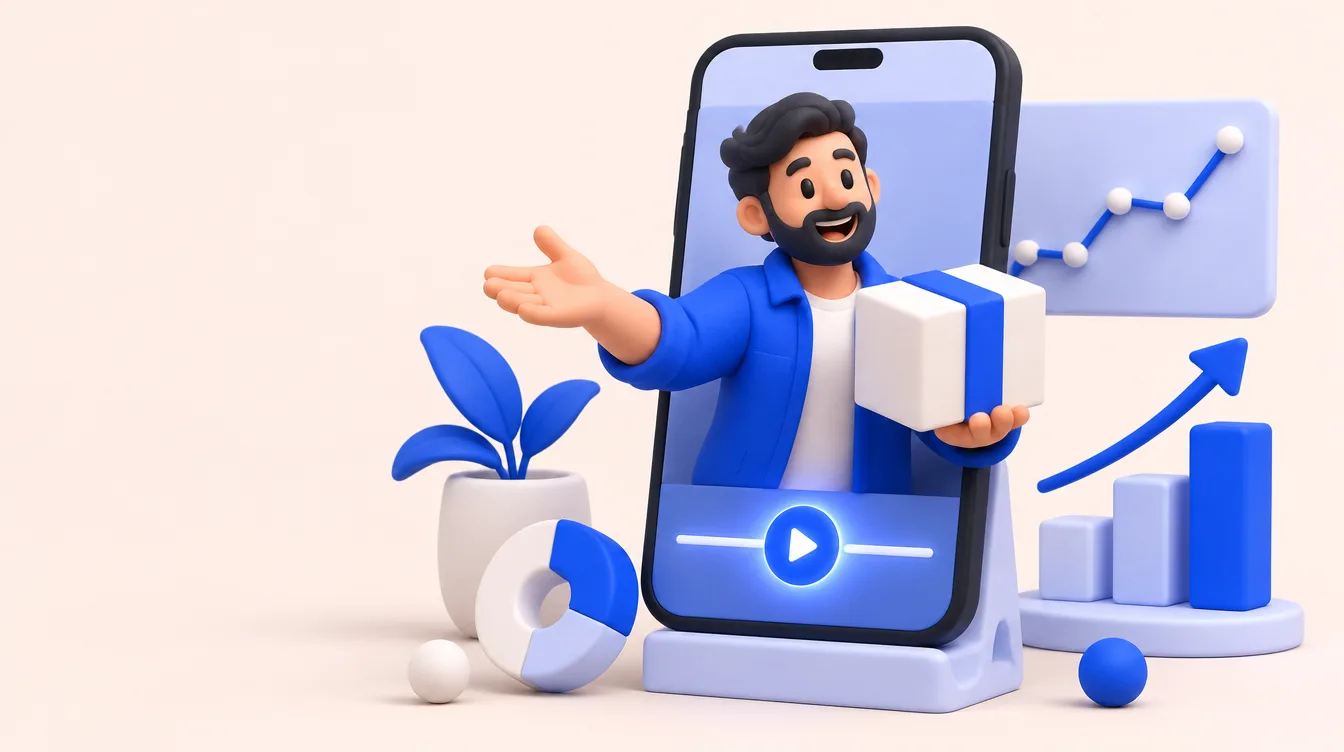
AI UGC video ads are short, selfie-style videos where an AI avatar or a licensed digital actor reads your script with synced lip movement and voice, so they look like creator content without hiring a creator for every version. They work best for testing many hooks and angles cheaply, for product explainers and for localizing into several languages. They work worst when the ad depends on trust in a real person's experience, and they must be disclosed where platforms require it: TikTok treats fully AI-generated or significantly AI-modified media as a mandatory disclaimer case, and Meta labels ads made with its own generative AI tools.
This guide explains how AI UGC is made, the disclosure rules on Meta and TikTok, where it performs and where it backfires, and how to test it against human UGC with clear numbers.
How do AI UGC video ads work?
Most tools follow the same pipeline:
- Script. You write or generate a 15 to 45 second script: hook, problem, product, proof, call to action.
- Actor or avatar. You pick a stock avatar (often based on a licensed actor), or create a custom avatar of a real person who has given consent.
- Voice and lip-sync. Text-to-speech generates the voice in the chosen language, and the model syncs mouth movement to it.
- B-roll and edits. Product shots, screen recordings or generated clips are cut in, with captions and music.
- Variations. The same script is rendered with different hooks, actors, languages and aspect ratios.
Tools differ mainly in actor library, language quality, editing controls and price. Creatify, for example, lists 300 AI actors on its free plan and paid plans from $15/month (checked Nov 2026 on its pricing page). Arcads advertises a library of more than 1,000 AI actors but does not publish prices on its site. TikTok's Symphony Creative Studio offers stock avatars inside TikTok's ad tools. Our AI ad generator comparison covers prices and limits in more detail.
What are the disclosure rules for AI UGC on Meta and TikTok?
| Platform or rule | What it says | What to do |
|---|---|---|
| TikTok Ads Manager | AI-generated, synthetic or manipulated media is a mandatory disclaimer case when content is fully AI-generated or significantly modified by AI (TikTok help, updated Sept 2025) | Turn on the AI-generated content disclaimer for AI avatar videos |
| Meta (own tools) | Ads fully created or materially edited with Meta's generative AI features get "AI info"; next to "Sponsored" when there is an AI photorealistic human | Expect the label; do not try to hide it |
| Meta (third-party tools) | Meta said in 2025 it would detect third-party AI ads through industry signals and label them in "About this ad" | Assume AI avatar videos may be labeled |
| Meta political and social issue ads | Advertisers must disclose digitally created or altered image, video or audio | Avoid AI avatars here unless fully disclosed |
| US FTC reviews rule (effective Oct 21, 2024) | Bans fake consumer reviews and testimonials, including AI-generated ones | An AI actor must never pose as a real customer describing results |
The FTC point matters most for UGC style. A script like "I tried this and lost 8 kilos" read by an AI actor is a fabricated testimonial. A script like "Here's how this works in three steps" read by an AI presenter is a product explainer. Keep AI UGC in the second category. The full rule text is on the Federal Register, and local consumer rules in Mexico and LATAM apply on top.
When do AI UGC videos work, and when do they backfire?
| Works well | Backfires or adds risk |
|---|---|
| Testing 10 to 20 hooks before paying creators | Testimonials, before-and-after, "my results" scripts |
| Product explainers, how-it-works, FAQ answers | Health, finance and legal claims without review |
| Localizing one script into several languages or accents | Audiences that already distrust ads in your category |
| Software, apps and services where B-roll carries the proof | Products where touch, taste or fit must be shown by a real user |
| Fast refresh when ads fatigue | Brands built on a recognizable founder or community |
In practice, many teams use AI UGC as a test layer. They find the winning hook and angle with AI versions, then pay a real creator to record the proven script. That keeps the cost of failed ideas low and the final ad authentic.
How do you make an AI UGC video ad, step by step?
- Pick one objective and one audience. For lead-gen, optimize to a qualified lead or a conversation that becomes a sale, not just a lead.
- Write three hook styles. A question ("Still tracking leads in Excel?"), a bold statement, and a demonstration opener.
- Keep the body factual. Features, steps, price from, guarantee terms. No invented experiences.
- Choose actors that fit the market. Accent and setting matter: a Mexico City audience notices a Spain accent.
- Add real proof as B-roll. Screen recordings, real product footage, real reviews shown with permission.
- Caption everything. Many people watch muted.
- Turn on disclosure and name ads clearly. Include "AIUGC", hook and actor in the ad name so results are easy to read.
How should you test AI UGC against human UGC?
Example (hypothetical numbers): a solar installer in Guadalajara wants to test six hooks. A human creator charges about $3,500 MXN per video, so six videos cost $21,000 MXN. An AI UGC tool on a mid-tier plan costs about $1,000 MXN a month for enough credits to render all six. The team runs each hook with $5,000 MXN of spend.
| Step | AI UGC route | Human-only route |
|---|---|---|
| Production for 6 hooks | ~$1,000 MXN | ~$21,000 MXN |
| Test spend (6 × $5,000) | $30,000 MXN | $30,000 MXN |
| Winning hooks found | 2 (by cost per qualified lead) | 2 |
| Re-record winners with a real creator | 2 × $3,500 = $7,000 MXN | Already done |
| Total to reach 2 proven human ads | $38,000 MXN | $51,000 MXN |
The saving here comes from not paying creators for the four losing ideas. It only holds if the AI version predicts the human version reasonably well, so always run the re-recorded winner against the AI original for a week before scaling. Judge by cost per qualified lead or cost per sale from your CRM. A video that gets cheap clicks and unqualified leads is not a winner; see our guide on cost per lead vs cost per sale.
How do you know which AI UGC video drove sales?
Ads Manager tells you which video got leads and purchases Meta can see. It does not tell you which video produced customers who paid weeks later in your CRM, or which video led to a WhatsApp conversation that closed. That is the job of creative-level attribution.
Admira ties Meta, Google Ads, TikTok and Click-to-WhatsApp leads to CRM revenue at the campaign and ad level, and its Growth plan includes an AI ad creative generator. It is not an avatar video studio, so for high-volume AI actor videos you would pair it with a dedicated tool. For the Click-to-WhatsApp side, see WhatsApp ads attribution.
Who this is for, and who it isn't
- For: brands and agencies that need many video variations each month and have a clear script process.
- For: teams localizing one offer into several LATAM markets.
- Not for: ads whose message is "this happened to me". Use real customers.
- Not for: regulated categories without legal review of every script.
For the broader production process, including prompts and brand rules, read how to create ads with AI.
FAQ
Are AI UGC ads allowed on TikTok?
Yes, within TikTok's ad policies. TikTok lists fully AI-generated or significantly AI-modified media as a case that requires its AI-generated content disclaimer.
Does Meta label AI UGC videos?
Meta applies "AI info" to ads made or materially edited with its own generative AI tools, and said in 2025 it would detect and label some ads made with third-party AI tools.
Can an AI actor give a testimonial?
No. An AI actor describing personal results is a fabricated testimonial. In the US the FTC rule effective October 21, 2024 bans fake testimonials, including AI-generated ones.
How much do AI UGC tools cost?
It varies widely. Creatify lists plans from $15/month and a free plan with watermark (checked Nov 2026); Arcads does not publish prices on its website.
Do AI UGC ads perform better than real creators?
There is no reliable public benchmark. Test them against your own human UGC and compare cost per qualified lead or cost per sale.
Can I make an avatar of myself?
Many tools offer custom avatars of a consenting person. Check each tool's terms on likeness rights and how your recordings are stored.